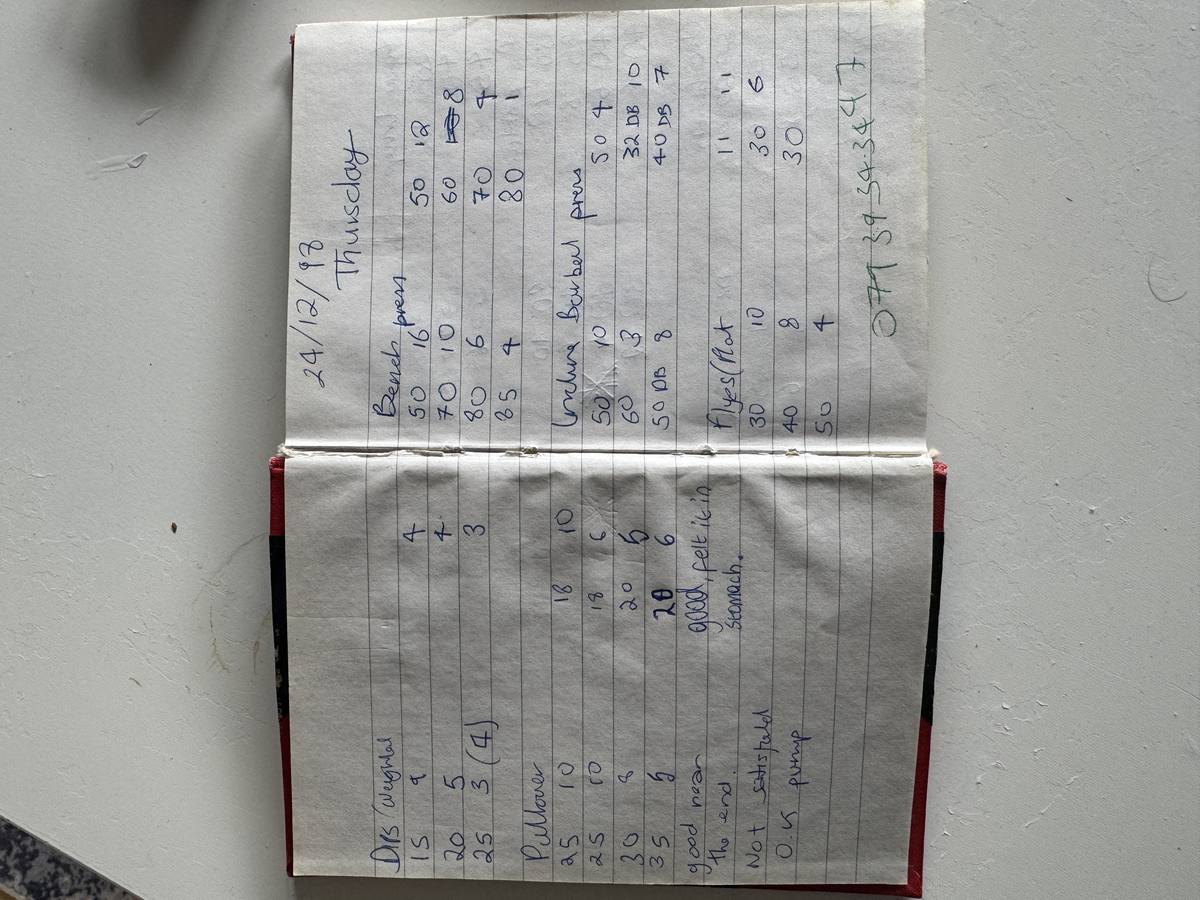
The date at the top of the page reads 24/12/98. Thursday. Christmas Eve. Dips with added weight, pullovers, bench press, incline barbell press, flat dumbbell flies. In the margin, in the same blue biro used for everything else: "good near the end. Not satisfied. OK pump."
The following day — 25/12/98, Friday, Christmas Day — the entries continue. Lateral raises. Arnold press. Behind the neck press. Dips. Close bench. More sets, more weights, more honest notes about what worked and what did not.
I did not record these sessions after the fact, sitting on a sofa with a protein shake, reconstructing what I thought I might have lifted. I wrote them down during the workout itself, between sets, in real time, in the gym. Because that is the only way it means anything. That is what the notebook was for.
The Man Who Showed Me
I did not invent this habit. Someone gave it to me. A man in a gym — a good man, the kind you used to find in gyms before they became performance spaces and social media sets — noticed that I was training without any record of what I had done the week before. He told me, simply and without any ceremony, to start writing it down. He handed me the idea the way experienced people in gyms used to pass things on: directly, practically, without any fuss.
I bought a small notebook from WH Smith. It cost next to nothing. I have never forgotten the advice.
This was 1998. There was no social media. There were no smartphones. Headphones were a luxury that most people in the gym simply did not have. People spoke to each other between sets. They asked about exercises, about programmes, about what worked. Knowledge passed between people in person, in real time, across a weight bench or by the squat rack. A man who knew something useful told a younger man who did not. That was how it worked. It was a better system than most of what replaced it.
What the Log Actually Shows
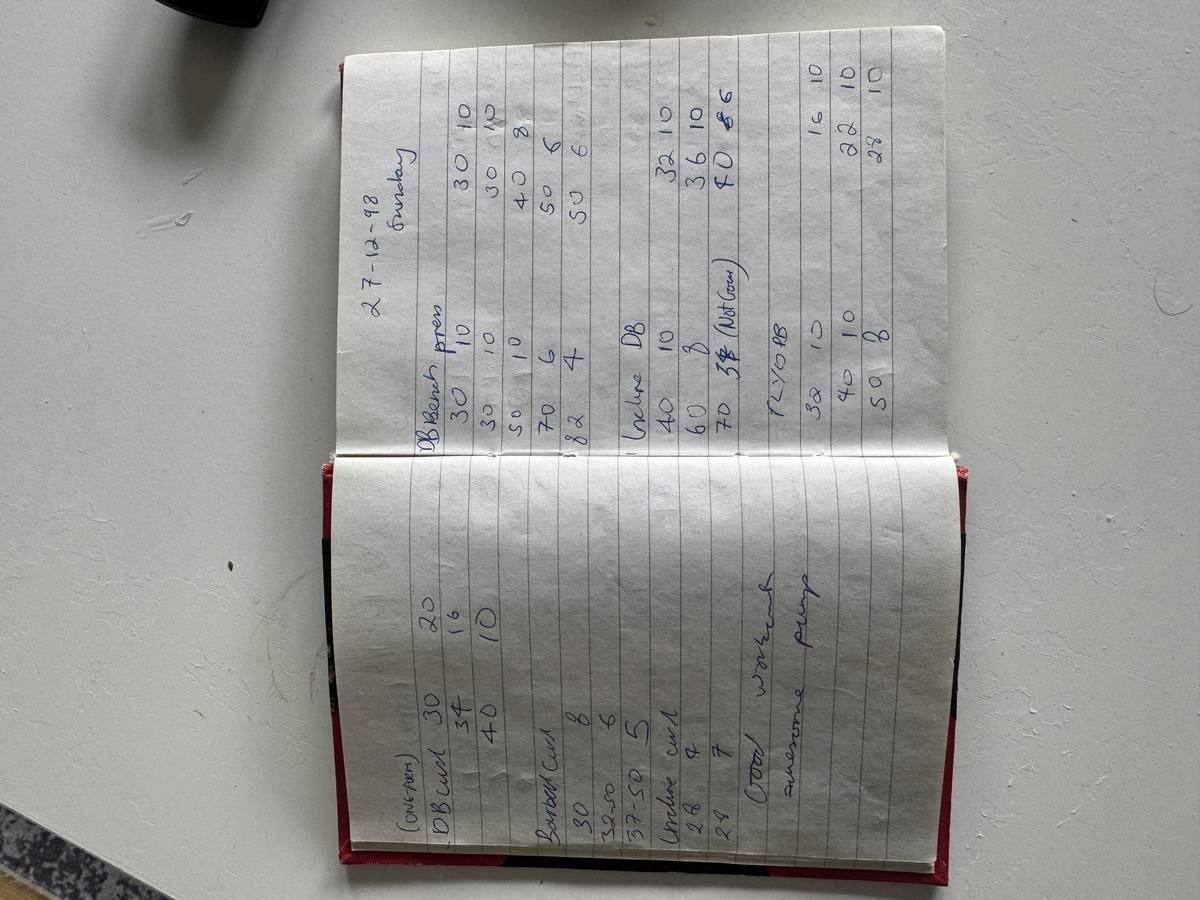
Look at the pages in the photographs. The entries are precise. Each exercise is named. Each set is recorded with the weight and the repetitions achieved. Where something went wrong — a set that fell short, a weight that proved too ambitious — it is noted honestly. Where something went well, that is noted too: "good workout, awesome pump" on the 27th of December; "good, felt it in stomach" on another entry. These are not the records of someone performing for an audience. They are the private, functional notes of someone trying to get stronger and tracking whether they are succeeding.
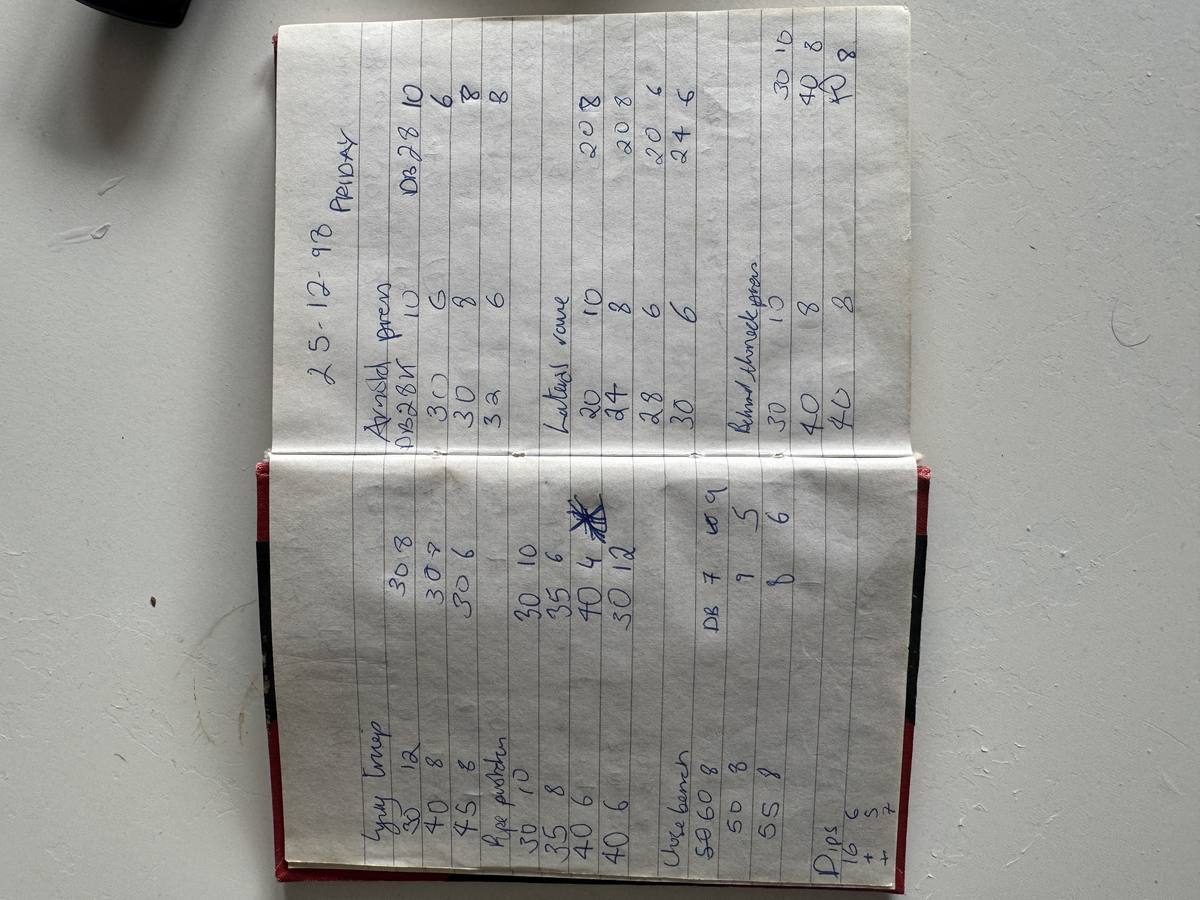
Some pages from the earlier period — 1997 and the beginning of 1998 — have been lost. They were torn out at some point, by whom or why I cannot now say with certainty. What remains starts partway through a story that began earlier. I find this both frustrating and somehow fitting. The data that is gone cannot be recovered. The habit that produced it has never left.
Why Writing It Down Works
The training log solves a problem that most recreational trainees do not even realise they have: the absence of honest feedback. Without a record, the human mind is remarkably good at constructing a flattering version of events. The set that was hard becomes the set that was heavy. The weight that was lifted once, on a good day, after a full night's sleep and an excellent meal, becomes the weight that is routinely lifted. The session that was mediocre is remembered as solid. Memory is not a reliable training partner.
Written records are. A number on a page does not have a bad memory or a tendency toward optimism. It does not care how the session felt. It simply records what happened, and in doing so creates a permanent reference point against which all future sessions can be measured. Progress becomes visible. Stagnation becomes visible. The sessions where something exceptional happened are preserved. The sessions where it did not are equally preserved — which is often more useful.
"If you are not writing it down, you are not training — you are exercising. There is a difference. One has a direction. The other simply has an effort."
— oldschoolPT
There is also something that the record does to the psychology of training that no amount of motivation can replicate. When you know that what you do in this session will be written down — that you will have to look at those numbers next week and the week after — you train differently. The temptation to cut a set short, to take an extra minute's rest, to leave the gym slightly earlier than you should, is countered by the knowledge that the page will reflect it. The notebook holds you accountable in a way that good intentions never can.
The Smartphone Excuse
Every person who reads this article has a smartphone in their pocket or within arm's reach. That device has more computing power than existed in most organisations in 1998. It can record video, track heart rate, calculate one-rep maxes and connect instantly to every piece of fitness information ever published. It can do, in seconds, everything that took considerable effort in the era of the red WH Smith notebook.
And yet the majority of people who train regularly keep no record whatsoever of what they have done. They arrive at the gym, they perform exercises at weights that feel about right, and they leave. They do this for months and years. They wonder why progress is slow or why it has stopped. The answer, more often than not, is that they have no way of knowing whether they are progressing because they have nothing to measure progress against.
Use the smartphone. Use a notebook. Use the back of an envelope if necessary. Write down what you lifted, how many sets, how many repetitions, and a brief honest note about how the session went. Do this every session, without exception, and review it regularly. Within three months you will have more useful information about your own training than most people accumulate in a decade.
What You Can Learn From Looking Back
I can open these pages now — nearly thirty years after they were written — and read exactly what I was doing in a gym on Christmas Eve 1998. I know the weights I was using, the exercises I chose, the order I performed them in and how the sessions felt at the time. I can trace the progression of a particular lift across weeks and months. I can see where I pushed harder than was probably wise and where I held back. I can see, in the handwriting of a younger version of myself, the same instincts and the same approach to training that I hold today.
That continuity is not incidental. The log did not just record what I did — it shaped what I became as a trainer. It taught me to think about training as a process with a direction rather than a series of disconnected efforts. It taught me that the data matters, that honest assessment matters, and that the gap between where you are and where you want to be can only be measured if you know precisely where you are.
A good man in a gym told me to start writing it down. I have not stopped since. If you are not doing it already, start today. You will thank yourself in thirty years.
"The notebook does not lie. It does not have a bad memory or a tendency toward optimism. It simply records what happened."
— oldschoolPT